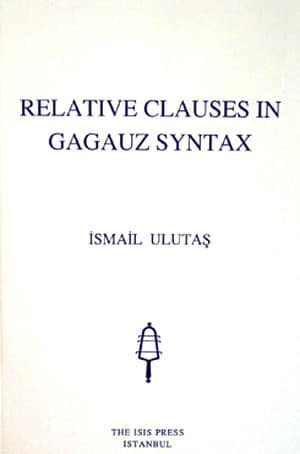
Acknowledgements; List of Abbreviations; 1 Introduction; Aims and scope of the study; 1.2 Organization of the study; 1.2.1 Translations, transcriptions and glosses; 1.2.2 The alphabet of Gagauz; 2 Historical Background and a general overview of Gagauz; 2.1 Locations of Gagauz Communities; 2.1.1 About the Gagauz language; 2.1.1.1 Dialects of Gagauz; 2.1.2 Historical Background of the Gagauz: Migration and Resettlement; 2.1.3 The alphabet; 2.2 The ethnogenesis of the Gagauz; 2.3 Studies about the Gagauz; 3 A general outline of Gagauz syntax; 3.1 Sentence structure; 3.1.1 Declarative sentences; 3.1.2 Interrogative sentences; 3.1.2.1 Leading yes-no questions; 3.1.3 Imperative sentences; 3.1.3.1 Negative imperatives; 3.2 The main members of the sentence; 3.2.1 Subject of the sentence; 3.2.2 Predicate of the sentence; 3.2.2.1 Verbal predicate; 3.2.2.1.1 Verbs without subjects; 3.2.2.1.2 Verbs without direct objects; 3.2.2.1.3 Compound verbal predicate; 3.2.2.1.4 Compound verbal predicate with a verb in infinitive; 3.2.2.2 Copular sentences (nominal predicate); 3.2.2.2.1 Copular sentences with adjectival complement; 3.2.2.2.2 Copular sentences with adverbial complement; 3.2.2.2.3 Var/yok; 3.2.2.2.3.1 Var nicä/var nası(l); 3.2.2.2.3.1.1 Ability; 3.2.2.2.3.1.2 Possibility; 3.2.2.2.3.2 Yok nicä/yok nası(l); 3.2.2.2.4 Lääzım; 3.2.2.2.5 Negative copula diil; 3.3 The secondary members of the sentence; 3.3.1 Object; 3.3.2 Oblique cases; 3.3.2.1 Dative: -(y)A; 3.3.2.2 Locative: -DA; 3.3.2.3 Ablative: -DAn; 3.3.2.4 Instrumental: -lAn, -nAn; 3.3.2.5 Equative: -AA, -CasInA ; 3.3.2.6 Vacillations in case suffixes; 3.4 Word order in basic sentence structure; 3.4.1 Predicate preceding the subject; 3.4.2 Subject preceding the predicate; 3.4.3 Word order in genitive-possessed noun phrases; 3.5 Complex sentences; 3.5.1 Without connecting words; 3.5.2 With connecting words (coordinate clauses); 3.5.2.1 Coupling; 3.5.2.1.1 da; 3.5.2.1.2 ne ? ne; 3.5.2.1.3 hem; 3.5.2.2 Contrast; 3.5.2.2.1 ama; 3.5.2.2.2 sa; 3.5.2.3 Alternation; 3.5.2.3.1 ya ? ya; 3.5.2.3.2 osa; 3.5.2.3.3 ili; 4 Relative constructions as a universal grammatical category; 4.1 Some preliminary definitions; 4.2 Restrictive versus non-restrictive relative constructions; 4.3 Infinite relative clauses; 4.3.1 Participles in Gagauz; 4.3.1.1 Free participles; 4.3.1.1.1 The ?(y)An participle; 4.3.1.1.2 The ?mIş participle; 4.3.1.1.3 The ?(y)AcAk participle; 4.3.1.1.4 The ?(I~A)r participle; 4.3.1.1.5 The ?mA; 4.3.1.1.6 The ?(y)IcI; 4.3.1.2 Possessed participles; 4.4 Nominalization; 4.4.1 Subject expression in nominalizations; 4.5 Attribution; 4.5.1 Free participles as Attributes; 4.5.2 Possessed participles as attributes; 5 Finite relative clauses; 5.1 Questions and relative clauses (interrogative pronouns and relative pronouns); 5.1.1 kim; 5.1.2 ne; 5.1.3 näanı/nerey(ä); 5.1.4 näanda/ner(e)dä; 5.1.5 näandan/ner(e)dän; 5.2 Complements for finite relative clauses; 5.2.1 kim; 5.2.2 ne; 5.2.3 angı; 5.2.4 näanı/nerey(ä); 5.2.5 näanda/ner(e)dä; 5.2.6 näandan/ner(e)dän; 5.2.7 nezaman/nevakıt; 5.2.8 açan; 5.2.9 ani; 6 Finite complement clauses and adverbial clauses; 6.1 Differences between finite complement and relative clauses; 6.2 Complementizers used in complement clauses; 6.2.1 kim; 6.2.2 ne; 6.2.3 naşäy/naşey; 6.2.4 nesoy; 6.2.5 nicä/nası(l); 6.2.6 näanı/nerey(ä); 6.2.7 näanda/ner(e)dä; 6.2.8 näandan/ner(e)dän; 6.2.9 nekadar; 6.2.10 nezaman/nevakıt; 6.2.11 ani; 6.2.12 ki; 6.2.13 aniki; 6.3 Adverbial clauses; 6.3.1 Time clauses; 6.3.2 Reason clauses; 6.3.2.1 neçin ki; 6.3.2.2 neçin deyni; 6.3.2.3 çünkü; 6.3.2.4 zerä; 6.3.2.5 ani; 6.3.2.6 ani ki; 6.3.2.7 onuştan ki; 6.3.2.8 raz; 6.3.2.9 onuştan; 6.3.3 Purpose clauses; 6.3.3.1 ani; 6.3.3.2 ki; 6.3.3.3 deyni; 6.3.4 Conditional clauses; 6.3.4.1 eer; 6.3.4.2 raz; 6.3.5 Concessive clauses; 6.3.5.1 eer ? da; 6.3.5.2 makar ki; 6.3.5.3 makar ani; 6.3.5.4 makar; 7 Conclusion; 7.1 Relative clause constructions in other Turkic languages; 7.1.1 Infinite relative clauses; 7.1.1.1 Using participles without possessive morphology; 7.1.1.2 Using participles with possessive morphology; 7.1.1.2.1 Participles without possessive morphology; 7.1.1.2.2 Participles with possessive morphology; 7.1.1.2.2.1 Possessive suffix is on participle; 7.1.1.2.2.1.1 The genitive subject; 7.1.1.2.2.1.2 The nominative subject; 7.1.1.2.2.2 Possessive suffix is on the head noun; 7.1.1.2.2.2.1 The genitive subject; 7.1.1.2.2.2.2 The nominative subjectf; 7.1.2 Finite relative clauses; 7.2 Conclusion on Gagauz; 8 Bibliography.
Boyut (cm.): 16x24, Sayfa Sayısı: 220, Basım Yeri: İstanbul, Basım Tarihi: 2004, Kapak Türü: Karton kapak, Kağıt Türü: 1. hamur